Recent News & Market Context
POPCAT, a Solana-based memecoin, recently went through a dramatic manipulation event on Hyperliquid that shook trader confidence. Someone placed a massive fake buy wall worth around $25 million, then pulled it without warning. The result? Cascading liquidations that cost the exchange nearly $4.9 million and sent POPCAT’s price tumbling roughly 43% down to $0.12. Traders are understandably spooked about price manipulation and liquidity issues after this incident.
Looking at the fundamentals, POPCAT has about 980 million tokens fully circulating, putting its market cap somewhere between $95 and $100 million. Daily trading volume sits under $10 million—pretty modest compared to its previous peaks. The memecoin space on Solana is crowded too, with competitors like BONK and WIF grabbing more attention and partnerships. While POPCAT did get added to PancakeSwap’s yield farms recently, which is nice for utility, it hasn’t really changed the token’s speculative nature yet.
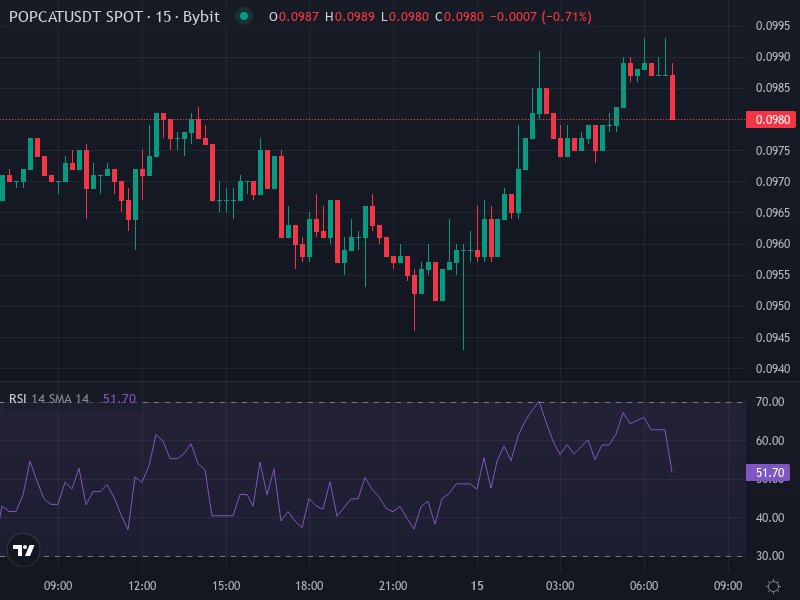
Technical Indicators from $0.0987 Today — What the Charts Say
Trading at $0.0987 right now, POPCAT is sitting below several important moving averages that are acting like a ceiling. The short-term moving averages—5, 10, and 20-day—are all above the current price, and so are the longer 50, 100, and 200-day averages. This paints a picture of an asset in a downtrend trying to find its footing.
Momentum-wise, things are lukewarm. The RSI is hanging around the low-to-mid 40s, showing weak momentum but not screaming “oversold” either. The MACD is tilting slightly negative, while Williams %R and Stochastic indicators hint that we might be oversold in the short term—which could mean a bounce is possible.
The trend itself has some strength behind it, with ADX readings in the low 30s suggesting the downward movement has conviction. Volatility is also running high, partly because there just isn’t much liquidity sitting in the order books. This makes POPCAT vulnerable to sudden swings on relatively low volume—something we’ve already seen play out.
Support seems to be forming around the $0.09-$0.10 zone. If that breaks, we could see prices slide toward $0.07-$0.08. On the upside, immediate resistance sits at $0.11-$0.12. Getting back above $0.15 would require either strong macro conditions or a fresh wave of meme coin hype.
Short-Term to Mid-Term Price Predictions & Risks
If the current support around $0.095-$0.10 manages to hold, we could see a short-term bounce back toward $0.11-$0.12. This would be especially likely if trading volume picks up, sentiment around Solana memecoins improves, or lower gas fees bring traders back in. Those oversold indicators we mentioned could spark a quick rally from short covering. That said, the resistance zone between $0.11 and $0.13 will probably be tough to crack, and we’d likely see the price tested back down.
If support gives way below $0.09, things could get ugly fast—a drop toward $0.07-$0.08 becomes the more likely scenario. Given what we’ve seen with manipulation risks and thin liquidity, a breakdown could spiral quickly. Any negative news—exchanges pausing withdrawals, whale sell-offs, or another manipulation incident—could trigger outsized moves in either direction.
Longer-Term Scenarios (6-12 Months)
In the best-case scenario, POPCAT rebuilds trust, volume returns, it gets listed on more exchanges, and catches a wave during a broader Solana memecoin rally. Under those conditions, the token could work its way back to somewhere between $0.20 and $0.25. But let’s be realistic—hitting its all-time high around $2.07 again seems extremely unlikely unless there’s a massive shift in utility or adoption.
On the flip side, if current problems persist—ongoing manipulation concerns, poor liquidity, or just a general cooling of speculative interest—POPCAT could get stuck trading in a range between $0.05 and $0.15. Without fresh catalysts, downward pressure would probably keep building whenever broader market excitement fades.