
Recent News & Ecosystem Developments
ApeCoin has been making waves in early 2026 with a series of community events and strategic ecosystem moves. The team held their regular “Meet at the Clubhouse” session in Otherside on January 22, paired with an AMA on X. While these events help keep the BAYC and Otherside communities engaged, they’re more about maintaining narrative momentum than driving actual protocol upgrades—so take them as sentiment boosters rather than fundamental catalysts.
On the development front, there’s been buzz around Project R.A.I.D., an ambitious multi-chain expansion aiming to bring APE to Solana, BNB Chain, and Hyperliquid. The goal here is to boost liquidity and expand DeFi utility for the token across different ecosystems—potentially a game-changer if executed well.
Worth noting is a major governance shakeup from mid-2025: token holders voted overwhelmingly (about 99.66% in favor) to shift from the decentralized ApeCoin DAO model to a more centralized structure under ApeCo, with Yuga Labs taking the reins. The rationale was faster decision-making and execution, though it’s sparked some debate about whether token holders are giving up too much influence in the process.
Current Technical Indicators & Chart Signal Analysis
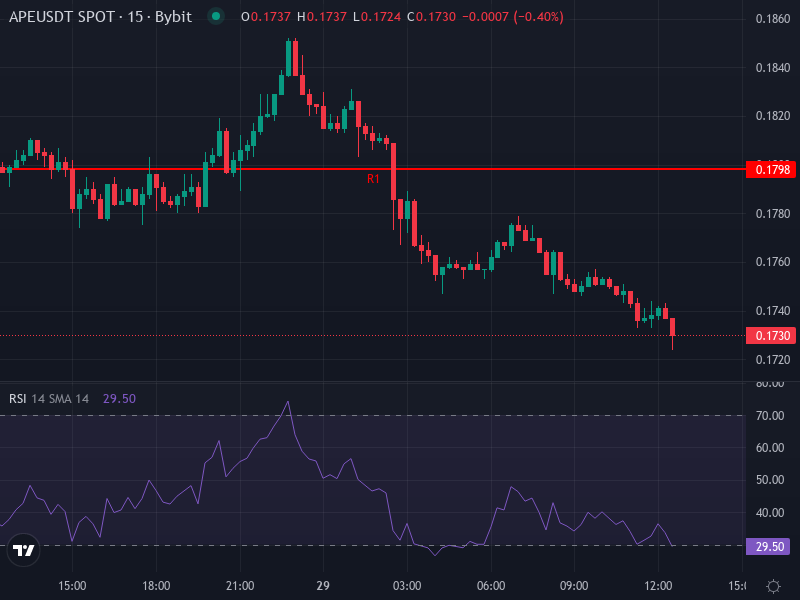
Right now, APE is hovering around $0.1731, having shed roughly 3.7% in the last 24 hours. Looking at the 4-hour chart, the RSI sits near 33.5—getting close to oversold territory but not quite there yet. This suggests the selling pressure is strong, but we haven’t hit panic-dumping levels.
The 4-hour MACD paints a similarly cautious picture: the MACD line is sitting below its signal line (around -0.00265 vs -0.00207), with a slightly negative histogram. Translation? Short-term momentum is leaning bearish, though not dramatically so.
Price action is currently beneath key moving averages on the 4-hour timeframe—the SMA is around $0.1807 and the EMA near $0.1816, both acting as overhead resistance. Zoom out to daily and longer timeframes, and APE is trading well below its 50- and 200-period moving averages, confirming that the broader trend remains bearish.
For day traders watching pivot points, resistance levels to watch are $0.1798 (R1), $0.1868 (R2), and $0.1904 (R3). On the flip side, support zones sit at $0.1692 (S1), $0.1656 (S2), and $0.1586 (S3).
Momentum & Volatility Assessments
Volatility has picked up noticeably—ATR readings and volume patterns show bigger candle swings in recent sessions, though price has been somewhat range-bound between established support and resistance levels.
Several shorter-timeframe oscillators—CCI, Williams %R, and Stochastic RSI—are creeping into oversold or near-oversold zones. This could signal a potential bounce in the very short term, especially if we see some buying interest materialize. That said, longer timeframe indicators aren’t showing any bullish confirmation yet, which means any relief rally could be short-lived or run out of steam quickly without fresh catalysts.
Price Forecast & Scenario Planning
Taking everything into account—the technical setup, recent news, and current sentiment—here’s how things might play out over the next few weeks and months:
Short-term (1-4 weeks):
If buyers start showing up, we could see APE test resistance around the $0.180–$0.185 zone. A clean break and hold above that level might open the door to R2 near $0.1868. However, if the price struggles to reclaim $0.180, we’re probably looking at a drift down to immediate support around $0.1692, with a real risk of sliding toward $0.1655 if momentum stays weak.
There’s a decent chance of a relief bounce if the RSI dips further into oversold territory (below 30) and we get some bullish divergence on the MACD. But don’t expect fireworks—any significant upside breakout would need a proper catalyst to back it up.
Medium-term (2-3 months):
For a sustained recovery, APE needs to show real progress on multiple fronts. That means tangible adoption from Project R.A.I.D., evidence of liquidity flowing across chains, or meaningful product launches tied to BAYC and Otherside. Without these catalysts, it’s hard to build a bullish case.
Given that price is trading so far below most long-term moving averages, there’s a gauntlet of resistance waiting between roughly $0.20 and $0.30. Breaking through those levels would be necessary to flip the trend from bearish to neutral or bullish.
On the downside, if the broader crypto market stays risk-off or if long-term holders start exiting positions to cut losses, we could see a gradual drift toward $0.150 or even lower.
Insight: Trading Strategy & Risk Considerations
If you’re actively trading APE, tight risk management is absolutely critical right now. The setup shows bearish momentum with overhead resistance and weak (but not collapsed) RSI readings. For aggressive traders, long entries might make sense at strong support levels or on confirmed reversal signals—think bullish MACD crossover with rising volume on a bounce.
Scalpers might find opportunities in the $0.165–$0.180 range, but should absolutely use stop-losses just below key support (maybe under $0.160) and keep position sizes modest relative to total capital.
For longer-term holders, the real question isn’t about timing the perfect bottom—it’s whether the infrastructure play actually delivers. Will the cross-chain integration work? Will governance stabilize and produce results? If Project R.A.I.D. and the ApeCo transition lead to measurable adoption, that’s when the fundamentals could catch up to price. Until then, patience and careful position management are your best friends.