
As mainstream investors mull over the early 2026 crypto landscape, all eyes are on Cardano (ADA) as it revisits a historically key demand zone. The third-generation blockchain, known for its measured approach to development and formal academic roots, has recently surrendered a large portion of its 2025 rally. Now, with prices hovering between $0.28 and $0.30, the market faces a crucial test—one that could define whether ADA enters a deeper correction or rebounds into a new accumulation cycle.

ADA Tests Historic Support Amid Broader Market Pressure
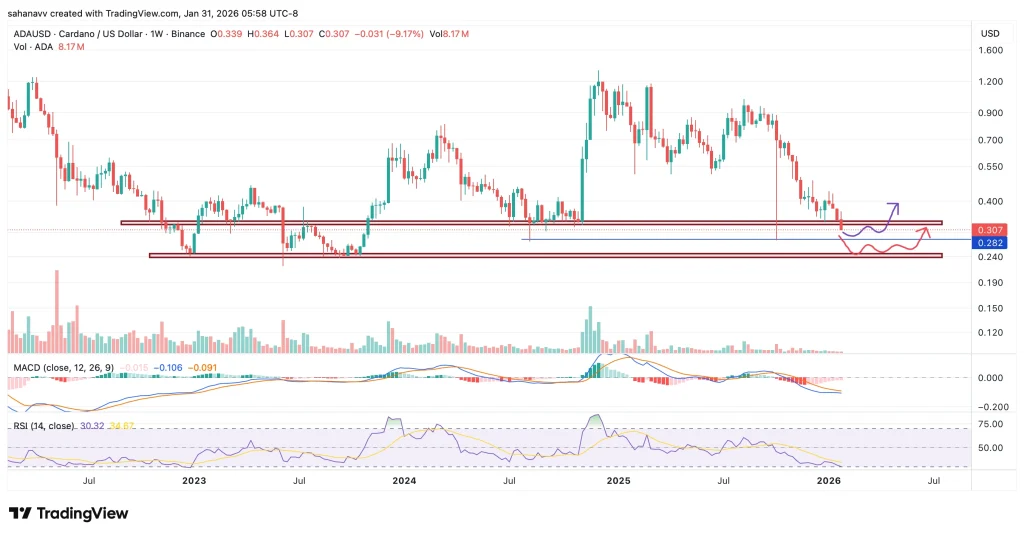
Trading at approximately $0.30, ADA has retraced nearly 33% from its highs earlier this cycle. The steep decline follows an extended distribution pattern that began in Q4 2025, as buyers failed to maintain momentum beyond the ( $0.45 ) region. Presently, ADA finds itself compressed within a narrow price band—$0.28 to $0.30—that previously sparked major price pivots in both bull and bear cycles. A make-or-break moment is now at hand.
This price zone isn’t just significant technically—it also represents a broader psychological threshold. Institutional interest, developer activity, and on-chain staking metrics have all held relatively steady, but speculative capital has clearly rotated out. That deterioration in positive sentiment is visible in weekly candlestick structure, which shows consistent lower highs and extended wicks—a classic sign of trapped liquidity and failed breakout attempts.
Bearish Momentum Builds, But Oversold Signals Linger
Indicators on the weekly timeframe confirm mounting bearish pressure but also highlight potential for reactive buying. The RSI has fallen below 35—flirting with historic oversold territory last seen during mid-2023’s consolidation. MACD dynamics remain firmly negative, underscoring a lack of directional reversal. Combined, these tools describe a market that isn’t exhausted but is entering a technically sensitive threshold.
Two potential technical trajectories are now emerging. The bullish scenario envisions buyers defending the current demand zone, with ADA forming a rounded consolidation base. A rebound from here could target the $0.36 to $0.40 zone, spurred by dip-buying and algorithmic re-entries. Conversely, a weekly closing below $0.28 would open the floodgates for further downside, with the next major structural support lying near $0.22—levels not seen since 2022.
Investor Sentiment Splits Across Communities
The Cardano community has long been one of the most vocal and engaged in the crypto ecosystem, but recent price activity has visibly dampened spirits. Social metrics from platforms like LunarCrush show a steady decline in bullish mentions since early January. Notably, high-profile influencers who once promoted ADA as an “Ethereum alternative with legs” have shifted focus to narratives involving Solana and Layer 2 projects.
However, a small but steadfast cohort remains optimistic. These advocates point to Cardano’s steady development roadmap, including the ongoing rollout of Mithril and Hydra protocol upgrades, as evidence that short-term price action doesn’t reflect long-term value. For them, this price range is less a warning sign and more a discounted entry for the patient.
Conclusion: A Defining Pivot for Cardano in a Maturing Crypto Landscape
The coming weeks will likely be decisive—not only for ADA traders but also for how Cardano is positioned within the competitive smart contract arena. As the broader market seeks direction amidst macroeconomic uncertainty and regulatory headwinds, ADA stands at a confluence of technical fragility and fundamental resilience. If long-term investors begin rotating capital back in, we may witness the beginning of a multi-month recovery phase. But if historic support fails, it would signal deeper structural cracks and invite further cross-asset scrutiny.
Whether the $0.28–$0.30 range holds or breaks could very well determine if Cardano emerges as a comeback story in 2026—or becomes a cautionary tale in a thinning field of surviving Layer 1s.