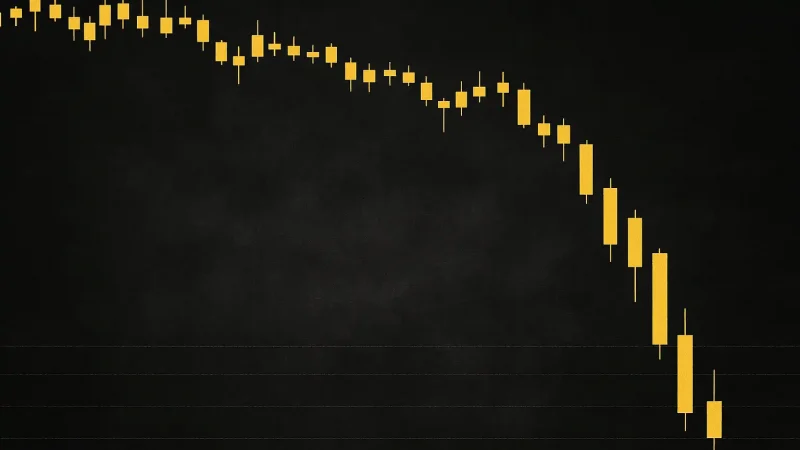

After a blistering run-up that briefly pushed Bitcoin toward six-figure territory, the world’s largest cryptocurrency is now consolidating below the $90,000 mark. While headlines might highlight the pullback, closer inspection reveals a market that is surprisingly resilient. Bitcoin’s current trajectory may not scream euphoria, but it offers a compelling study in market structure, momentum fatigue, and the calm before a new directional storm.
Price Consolidation Within a Long-Term Bullish Channel
On the weekly chart, Bitcoin remains well within its multi-month ascending channel, which has defined every major bounce since the 2023 recovery phase. Despite wicking above $100,000 earlier this cycle, BTC failed to anchor weekly candles in that zone and has now slipped to the $87,000–$88,000 range.
Importantly, this drift lower has not broken key structural thresholds. The modest decline in price is matched by lower trading volumes, a sign that the retreat isn’t panic-driven. Rather, this appears to be a market in digestion mode—a cooling-off period after frothy gains, not a structural unwind of bullish momentum.
Support Zones Becoming Battle Lines
If there’s a number to watch, it’s $85,000. This level has functioned as a soft floor in recent weeks and may soon define Bitcoin’s short-term fate. Sustained closes above that region would reinforce the notion that this is a healthy consolidation within a longer upcycle. Drop below with volume, and the next key demand zone sits closer to $74,000, where the lower boundary of the ascending channel aligns with prior accumulation.
Critical Technical Levels
- Immediate support: $85,000–$87,000
- Broader demand zone: $74,000–$75,000
- Overhead resistance: $95,000–$100,000
If bulls can reclaim the $95,000 handle, it would shift sentiment quickly, validating a range breakout and setting the stage to revisit all-time highs. Until then, traders are navigating a middle ground—still bullish in bias, but cautious by necessity.
What the Metrics Really Say: A Pause, Not a Pivot
It’s tempting to interpret Bitcoin’s inability to hold above $90,000 as a sign of trend reversal, but the technical backdrop argues otherwise. The MACD on the weekly time frame has begun to flatten rather than cross into bearish territory, signaling loss of momentum but not an outright reversal. On-Balance Volume (OBV) remains relatively strong, unchanged from local highs, indicating that long-term holders are not yet offloading en masse.
In trader terms, it’s a neutral tape with a bullish undertone—a range-bound market with an upward bias so long as major support zones remain unbroken.
Potential Outcomes in Sight
Scenario 1: Consolidation Holds, Price Resumes Higher
If Bitcoin reaffirms the $85K–$87K region, momentum could tilt upward again by mid-Q1. The next push would likely retest the $95K–$100K barrier, and a breakout there would be technically significant—raising the stakes for a move toward new highs.
Scenario 2: Breakdown to Channel Base
Conversely, if bears push a weekly close beneath $85,000, it opens the door to deeper retracement. The $74K–$75K pocket becomes the natural gravitational target—a zone where stronger hands are expected to absorb selling, and where longer-term trendlines suggest macro continuation could still survive.
Strategy Check: Patience Over Aggression
For traders and long-term investors alike, the message here is discipline. Bitcoin is playing a waiting game, sorting through inflated expectations and recalibrating momentum. The bigger trend remains upward, but short-term conditions demand flexibility. Buying into support with tight invalidation, or waiting for reclaim of lost resistance, offers better precision than chasing price action in the middle of a range.
Ultimately, the market isn’t breaking down—it’s breathing. And in crypto, controlled breathing often precedes another sprint.