
Recent News & Ecosystem Shifts
The ApeCoin ecosystem is going through some pretty major changes right now. Yuga Labs decided to shake things up by essentially phasing out the ApeCoin DAO and replacing it with a new corporate structure called “ApeCo” after AIP-596 passed in mid-2025. Basically, they’re moving governance powers, treasury funds, smart contracts, and project assets over to ApeCo—the goal is to make decisions faster and funnel resources more directly into the stuff that matters most: ApeChain, BAYC, and Otherside. It’s a move that’s got holders split—some see it as streamlining things, others worry about centralizing control. Either way, how ApeCo performs in the coming months will be huge for sentiment around APE, especially as they’re trying to expand utility through ApeChain and make the token work across different blockchains.
There’s also been a big shift in how staking works. As of April 15, 2025, if you’ve got BAYC, MAYC, or BAKC NFTs and want to stake them, you’re not doing it on Ethereum mainnet anymore—it’s all moved over to ApeChain. They’re using something called “shadow” technology now, which ties soul-bound NFTs to your originals, so you don’t actually have to bridge your NFTs over. You do need to bridge your APE tokens though if you want to keep earning rewards. The upside? U.S. holders can finally stake through the official platform without workarounds. Keep in mind, this is the third and final year of APE’s staking reward program, which wraps up around March 3, 2026.
Technical Analysis Based On Current Price & Indicators
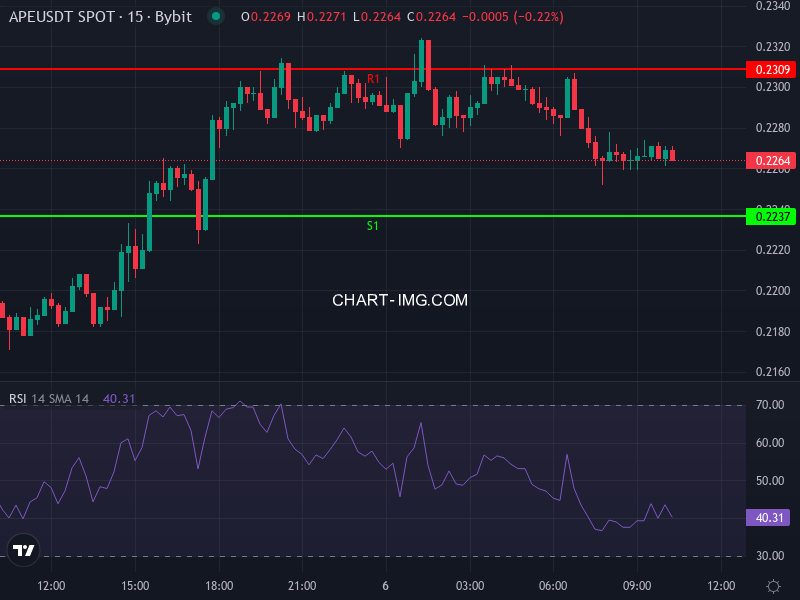
Right now, APE/USDT is sitting at around 0.22969 USDT, which is up about +3.84% in the last 24 hours. Looking at the 4-hour chart, the Relative Strength Index (RSI) is hovering near 61.6—that tells us there’s some bullish momentum building, but we’re nowhere near overbought territory yet. The MACD line just crossed above its signal line with a small positive histogram reading (around 0.00015), which backs up the idea that we might be in the early stages of a short-term uptrend.
The moving averages paint a similar picture. On the 4-hour timeframe, the Simple Moving Average (SMA) is sitting at roughly 0.21856, and the Exponential Moving Average (EMA) is at 0.21900. Since APE is trading above both of these, it’s a decent sign for the bulls. Looking at daily pivot points, we’ve got immediate resistance coming up at around 0.2309 USDT (R1), then 0.2352 (R2), and 0.2381 (R3) if things really get cooking. On the downside, support is hanging out near 0.2237 (S1), 0.2208 (S2), and 0.2165 (S3).
Key Price Levels & Scenarios
Bullish case: If APE can close above that ~0.2309 level on the 4-hour chart and actually hold it, we could see a push toward 0.235–0.238 USDT pretty quickly. Break through that with decent volume behind it, and suddenly 0.250 USDT starts looking realistic. The key things to watch would be the MACD continuing to strengthen and the RSI staying under control—ideally below 80—to confirm this isn’t just a fakeout.
Bearish case: On the flip side, if that 0.2309–0.235 resistance zone proves too tough to crack, we’re probably looking at a pullback toward support somewhere between 0.2208 and 0.2237. The real danger zone is below 0.2165—if that level breaks, things could get ugly fast with a drop toward 0.200 USDT on the table. Warning signs would be weak volume on the attempted breakout, divergence in the MACD showing weakening momentum, and RSI starting to roll over.
Neutral / consolidation case: Honestly, given where we are right now—pretty close to that mid-pivot zone around 0.2280 USDT—APE might just chop around sideways for a bit. We could easily see it bounce between 0.220 and 0.235 USDT until something big happens. That could be a major governance announcement, some exciting data about ApeChain adoption, or just a shift in the broader crypto market that forces APE to pick a direction.
Outlook & Forecast Through Mid-2026
With staking rewards winding down in this third and final year (ending March 2026) and all these governance changes happening, people are going to be watching ApeChain’s performance really closely. If ApeChain actually delivers—meaning real transaction volume, solid DeFi and NFT integrations, and developers actually wanting to build on it—that could create genuine demand for APE and push us above 0.25 USDT. But if there are hiccups with the ApeCo transition or bugs with the staking migration, that momentum could stall out fast and we’d be looking at downside risk instead.
Here’s how I see the different scenarios playing out (assuming we don’t get some massive crypto market meltdown):
- Baseline case: APE probably trades between 0.220 and 0.240 USDT heading into mid-2026, with a slow grind higher if the momentum holds and nothing breaks.
- Optimistic case: We break through resistance and push up to 0.260–0.300 USDT, especially if cross-chain demand really picks up and ApeChain becomes a legitimate hub.
- Conservative case: We fail at resistance, volume dries up, and we drift back down toward 0.200–0.210 USDT as people lose interest or take profits.
There are definitely some wildcards to keep in mind. The broader crypto market matters a lot—what Bitcoin and Ethereum are doing will influence APE whether we like it or not. Regulatory stuff could come into play, especially anything targeting NFT platforms or staking. Token unlocks or other supply events could create selling pressure. And honestly, a lot depends on whether ApeCo can actually execute better than the DAO did. APE’s price is going to be tied to both what’s happening on-chain (how many people are staking, how much ApeChain is being used) and external factors like macro policy, regulatory developments, and overall investor confidence in the crypto space.
Technical Prediction Snapshot
Looking at the next few weeks, I’d expect APE to test that 0.2309 USDT resistance level. If it breaks above, we’re probably headed toward 0.235–0.238 USDT. Hold that, and 0.250 USDT becomes the next target. If it gets rejected though, we’re likely pulling back into the 0.220–0.215 range. Zooming out to the next 3-6 months, if the governance transition goes smoothly and the utility expansion actually happens, I could see 0.260–0.300 USDT being realistic. But if things don’t pan out, 0.180–0.210 is probably where we find a floor.