
Current Context & Fundamental Drivers
Pudgy Penguins (PENGU) has been making some pretty interesting moves lately, stretching well beyond its NFT origins into something that looks more like a full-fledged Web3 brand. The recent licensing partnership with Schleich, along with pushes into lifestyle products, sports merchandise, and collectibles, shows they’re serious about building something with real-world relevance. This isn’t just speculation anymore—there’s an actual consumer ecosystem taking shape here, which definitely changes how we should think about the token’s technical patterns.
That said, things aren’t all smooth sailing. The SEC has pushed back its decision on a PENGU ETF until March 11, 2026, raising eyebrows about custody arrangements, valuation methods, and potential market manipulation. Naturally, this delay has dampened sentiment and caused a bit of a price dip. Still, there are signs that some institutional players have been quietly accumulating during quieter trading periods, which suggests at least some smart money believes in PENGU’s longer-term story despite the regulatory uncertainty.
Technical Indicator Breakdown
Let’s dig into what the charts are actually telling us right now with the latest 4-hour and daily readings for PENGU/USDT:
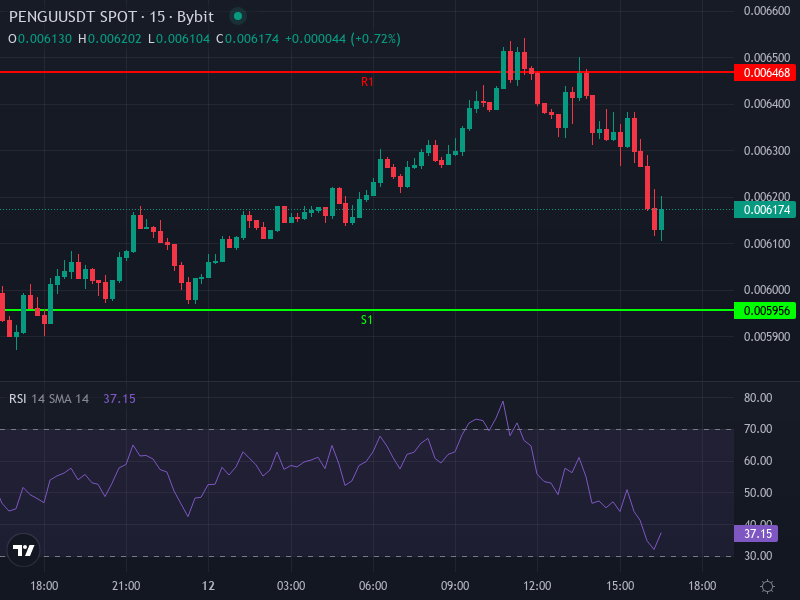
- Current Price: 0.0061722 USDT.
- 24-hour change: +3.89% — a modest bump upward, though we’re still bouncing around in a pretty choppy range.
- 4-hour Relative Strength Index (RSI): ~45.67 — sitting right in neutral territory with a slight lean toward weakness. We’re not seeing overbought or oversold extremes here.
- 4-hour MACD histogram: Slightly positive at around +0.0000491, with the MACD line nudging above its signal line — there’s a hint of bullish momentum forming, but it’s still pretty close to the zero line, so take it with a grain of salt.
- 4-hour Simple Moving Average (SMA): ~0.006288 — price is trading just beneath this level, which means we’ve got some overhead resistance to deal with.
- 4-hour Exponential Moving Average (EMA): ~0.0063168 — also sitting above current price, reinforcing that resistance zone on shorter timeframes.
- Daily pivot points:
- Resistance levels (R1–R3): 0.0064677, 0.0067613, 0.0069797
- Pivot: 0.0062493
- Support levels (S1–S3): 0.0059557, 0.0057373, 0.0054437
- Daily Rate of Change (ROC-p): ~ -20.9% — this shows the price has dropped roughly 20% compared to its reference period, pointing to some existing bearish pressure or a recent correction.
Key Resistance and Support Zones
Looking at those daily pivots, the first real hurdle sits right around **0.0064677 USDT (daily R1)**. If buyers can push through that level, the next zones to watch are **0.00676–0.00698 USDT** (R2 and R3), though getting there would take some serious momentum given where we are now. On the flip side, support is likely to hold near **0.0059557 USDT (daily S1)**. If that level gives way, things could get dicey quickly, with the next support zones around **0.00574–0.00544 USDT** becoming critical floors to watch.
Price Prediction Scenarios
Base Case (Neutral/Balanced)
If we keep drifting in this consolidation pattern, PENGU will probably bounce between **0.00595** and **0.00647** USDT for a while. With RSI in neutral territory and MACD showing only weak bullish vibes, I’d expect the price to test that **0.00647 USDT (R1)** resistance level. Breaking through would need either a volume spike or some positive news—maybe something on the ETF front or a big partnership announcement. Without that catalyst, we’ll likely see price drift back toward **0.00595 USDT (S1)** and potentially test that support structure.
Bullish Case (If Positive Catalyst Hits)
Now, if the SEC surprises everyone with ETF approval or even just encouraging language come March 11, 2026, and we get some solid brand partnership news or product launches to boot, the upside could really open up. In that scenario, breaking **0.00647 USDT** could lead to targets around **0.00676–0.00698** USDT. With enough momentum and broader altcoin market strength, we might even see a push toward **0.0072 USDT** (beyond daily R3), though that would require everything falling into place just right.
Bearish Case (If Negative Pressure or No Catalyst)
On the other hand, if regulatory news turns sour or we see broader crypto market weakness—think macro selloffs or risk-off sentiment—failing to break **0.00647 USDT** would likely mean a retreat back to **~0.00595 USDT**. Breaking below that support could send PENGU toward **0.00574 USDT (S2)** or even **0.00544 USDT (S3)**. In this scenario, RSI would probably drop into oversold territory (below 30), which could at least set up an interesting bounce play for contrarian traders.
Strategic Implications for Investors & Traders
For anyone trading this in the short term, tight risk management around these resistance and support zones is absolutely crucial. If you’re looking to go long, your best bet is probably catching dips near support around 0.00595 USDT, with stop-losses placed just below S1 to protect against bigger drawdowns. For profit targets, aim for R1 and R2, and consider scaling out along the way since those overhead resistance zones (where the SMA/EMA sit) could cap upside moves.
For those holding longer term, Pudgy Penguins’ transformation into a diversified consumer IP brand is genuinely interesting and suggests meaningful upside if their strategy with toys, games, and licensing actually scales. But regulatory clarity—especially around that ETF—remains a real wildcard. Anyone holding for the long haul should size their position accordingly, keeping in mind this is still a volatile token with roots in the meme/NFT space.
Short-Term Outlook (Next 4-8 Weeks)
Over the next month or two, PENGU will probably either consolidate in this range or make a run at resistance. If the ETF decision gets delayed again or comes with unfavorable conditions, expect downward pressure toward **0.00574–0.00544** USDT. But if we get positive regulatory signals paired with strong brand momentum—say, a new toy line or game launch—then a move above **0.00676 USDT** becomes realistic. Volume will be the deciding factor here; technical breakouts that aren’t backed by volume tend to fizzle out pretty quickly.